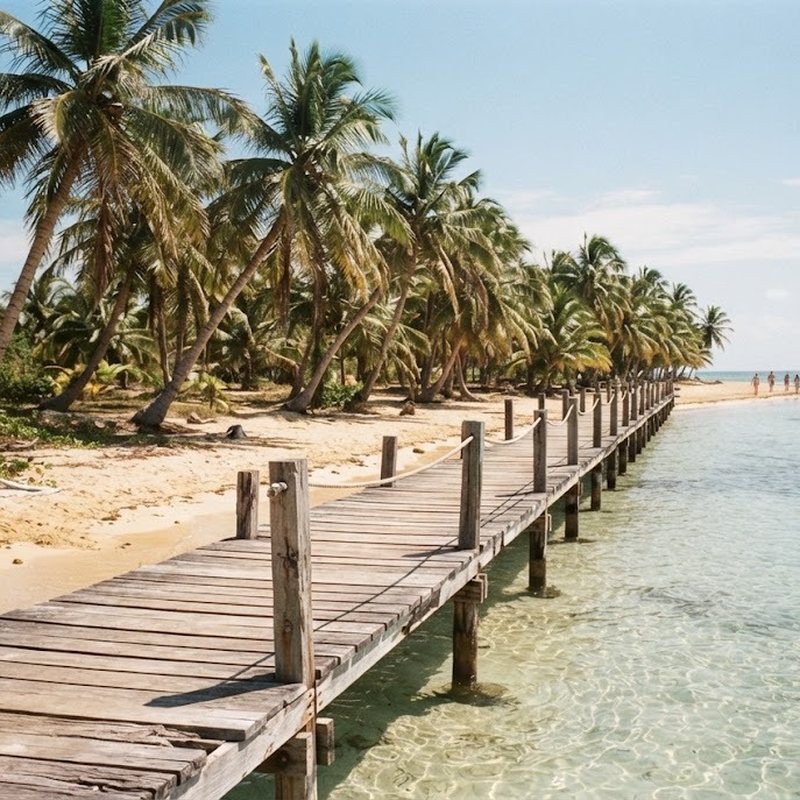
I keep getting the same questions from readers who have found one photograph of Champagne Beach and started planning around it, usually with a forum answer from 2016 attached. Those threads deserve short replies anyway, so this is what I tell people now, with the fares and hours I paid myself on my last two visits.
How do I reach Espiritu Santo without a yacht?
You fly, and the sensible route has one stop. Air Vanuatu runs the Port Vila to Luganville leg several times a day, the flight takes about forty minutes, and almost every itinerary from Australia or New Zealand arrives through Port Vila. A return on that domestic leg has cost me between 35,000 and 45,000 vatu depending on the month, which is roughly 300 to 380 dollars.
There is no passenger ferry from Port Vila, whatever older blogs still claim. Cargo ships cross now and then, they are not selling berths, and a trip planned around one is a trip planned on luck.
When should I book a bed in Luganville?
Book the first two nights before you fly and leave the rest loose. Luganville holds a couple of dozen rooms, the east coast holds far fewer, and the gap between those two facts decides whether you walk in tired in July.
From June to September a simple room runs 4,500 to 8,000 vatu a night and the emptier places fill first. In February the same rooms sit near 3,000 vatu, I have never queued for one, and the trade is honest: a few small guesthouses and cafes take a fortnight off, and the ones that stay open answer the phone slowly.
Do the cash machines work outside town?
Outside Luganville, assume they do not. The machines that matter sit in town near the market and the banks, and on a Sunday, when the ship comes in late, they can be empty by noon. I withdraw enough for three days and split it between two pockets.
- Market produce, nakamal shells, blue hole entry and village trucks take cash only.
- Small shops struggle with a 10,000 vatu note before nine in the morning; 500 and 1,000 notes move easily.
- Cards work at the larger resorts and at the dive operators, usually with a surcharge of a few percent.
One dollar buys about 120 vatu, which keeps the arithmetic simple: a shell of kava at 200 vatu is under two dollars, and a plate at the market costs 500 to 700. By the third day I stop converting altogether.
What does a day on the island actually cost?
Here is a plain day with no boat and no dive, as mine worked out last month. Every figure below is money I actually handed over, in cash, at the gate or the counter:
- Guesthouse: 5,500 vatu for a fan room with a screen on the window.
- Market breakfast and lunch: 700 to 1,000 vatu together.
- Hired car: 8,000 vatu for the day, or 3,000 for a scooter.
- Blue hole entry, ladder and rope swing included: 1,000 to 2,000 vatu.
- One beer and two kava shells after six: 1,000 vatu.
Add those and the day lands near 17,000 vatu, about 140 dollars with the room inside it. Two dives on the SS Coolidge run another 15,000 to 18,000 vatu with tanks and a guide, so a week plans itself from there.
Is the tap water fine, and do I need tablets?
In Luganville I filter or boil the tap water, and outside town I buy the five-litre jugs at 150 to 250 vatu, which beats bottles on price and on plastic. Fruit I peel myself, and cut pineapple at the market turns over fast enough to be safe.
For anything medical I ask a travel clinic before I fly rather than a forum afterwards, because the answer depends on the villages I plan to sleep in and the month I come. Repellent costs 300 to 500 vatu at any pharmacy in town, and I put it on before dusk whatever the guesthouse book says.
What changes in the wet months?
From November to April the rain usually arrives in the afternoon and clears by evening, so mornings stay usable and the roads soften rather than close. Prices fall by a quarter, Champagne Beach is empty after ten, and inland tracks stay slick underfoot for a day after heavy rain.
What really shifts is the timetable: some operators run one trip a day instead of two, a couple of places in town close for a break, and January to March carries cyclone risk that is not theoretical, since Pam took roofs off this island in March 2015. My rain plan is a list rather than an apology: market while it is cool, a long lunch, blue holes and the east coast on the first clear day.
How many days does the island really need?
Five, split like this: one for the town, the market and the nakamal; one for the SS Coolidge and Million Dollar Point; one for the east coast to Champagne Beach with lunch on the road; one for the blue holes inland; and one spare. Four days work if the spare is cut, but the spare is the day that catches a late boat or a closed door, and it usually becomes the one I remember.