Why I Switched Everything Off
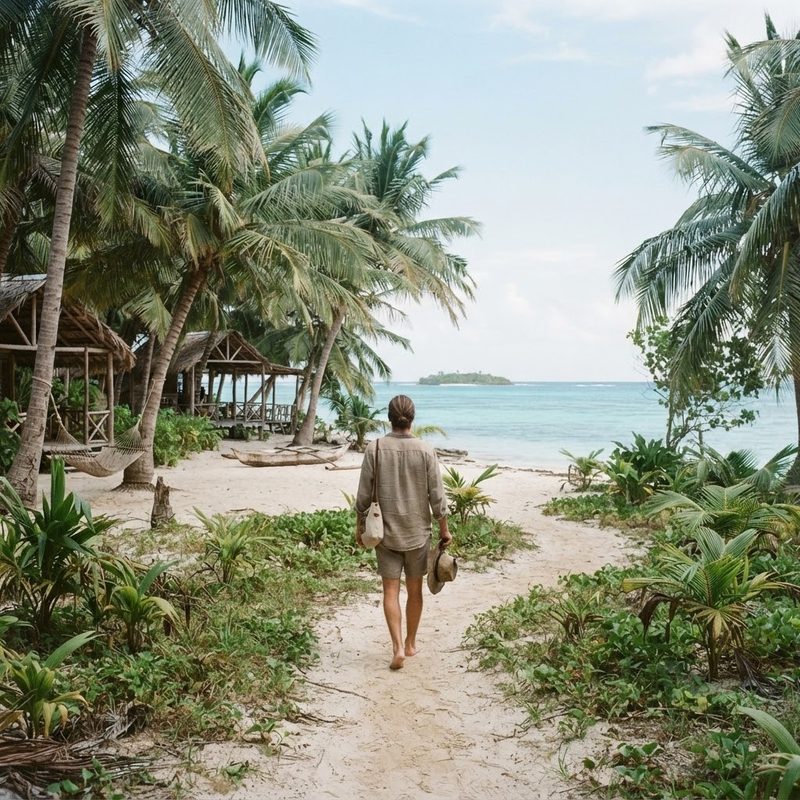
My phone is my camera, my map, my translator and my link to everybody who reads what I write. After more than a decade travelling alone, being online has always felt the same thing as being prepared.
Then I noticed that the connection I actually wanted was the one I kept avoiding: the place in front of me, and my own thoughts with no screen in between. The digital noise had turned into a constant hum underneath everything.
I had tried smaller versions before: the phone in airplane mode, the walk without it. They lasted an afternoon. This time there was no signal to fall back on and nobody waiting for a story by Friday, which is the only reason the experiment had any chance.
So I booked a bungalow on one of the small islands off Espiritu Santo, with no Wi-Fi, unreliable signal and fewer than two hundred people living there, and packed a journal, a few books and a fair amount of nerves. Seven days without a phone, a laptop, or any screen at all. The point was never to put the phone down. It was to look up.
The First 48 Hours
I expected calm straight away: meditation, hermit crabs, the usual postcard. Instead the first two days were loud. Not with sound, but with everything missing. My brain, used to a constant drip of information and reaction, went into withdrawal. I felt my pocket buzz where the phone was not. I finished a meal and my hands went looking for something to scroll.
The silence was vast and, honestly, uncomfortable at first. It turned my own thoughts up until they drowned out everything else. What is happening out there? Did that email land? What is everyone doing? The fear of missing out arrived as a physical ache. I paced the bungalow, repacked the same bag three times, and watched the sea and felt not wonder but a loose, drifting unease.
That phase taught me the first thing: our devices do more than fill time, they stand between us and the intimidating size of our own heads, and the unstructured reality of a day with nothing in it. The pull is not really toward connection. It is toward distraction.
A Different Rhythm by Day Three
By the third day the static thinned and the island came through. Morning light through the woven wall of the bungalow. Insects I could not see, running a complex chorus in the jungle. The exact colour the water went just before the sun dropped. My senses, dulled by screen light, were coming back online.
The days took their shape from the sun and the tide instead of a calendar. I woke at sunrise and walked the beach. I sat for hours watching a family mend fishing nets until they handed me a section, my awkward hands a source of gentle amusement for everyone there. Repetitive, slow, and more absorbing than any app I have downloaded.
- Clouds replaced the news feed, and they predicted the afternoon rain better.
- The island's history, told by the village elder, replaced any podcast.
- One sunset kept properly, rather than four hundred photographs.
- A twisted banyan tree did the work of a digital map.
This was never about rejecting technology. It was about finding the analogue tools I already carried. My eyes became the camera, my ears the podcast, the conversations the feed. Everything felt more solid, and far more satisfying.
Three Things I Brought Back
Going back online was as abrupt as leaving it. I did not return empty-handed, though: no tan, a few mosquito bites, and three things I still use.
Boredom is not a hole to plug, it is a space to walk into. We have become so frightened of an empty minute that we fill every one of them. Yet it was exactly in those flat, boring moments, staring at the water, waiting for a boat, that the good ideas arrived and my mind settled. Boredom is where creativity and self-reflection begin.
Real attention is the price of real connection. In one week I had more meaningful conversations with near-strangers than in months of messaging. Eye contact, listening without reaching for a notification, sharing the same physical space, that builds something no like or comment can copy.
And my relationship with time had broken. I used to treat days as lists to optimise. On the island, time moved: it stretched and shrank. An hour watching the tide come in was not an hour lost, it was an hour fully lived. I have not given up my phone, but that week changed its rank. It is a tool again, not the thing in charge. The changes that matter never arrive on a display. They show up in the quiet hour when you finally switch the thing off.
I have not repeated the full week since. But the phone now leaves the room for the first hour of the morning, and that one habit has outlasted every app I ever paid for.