How the Archipelago Got Its Name
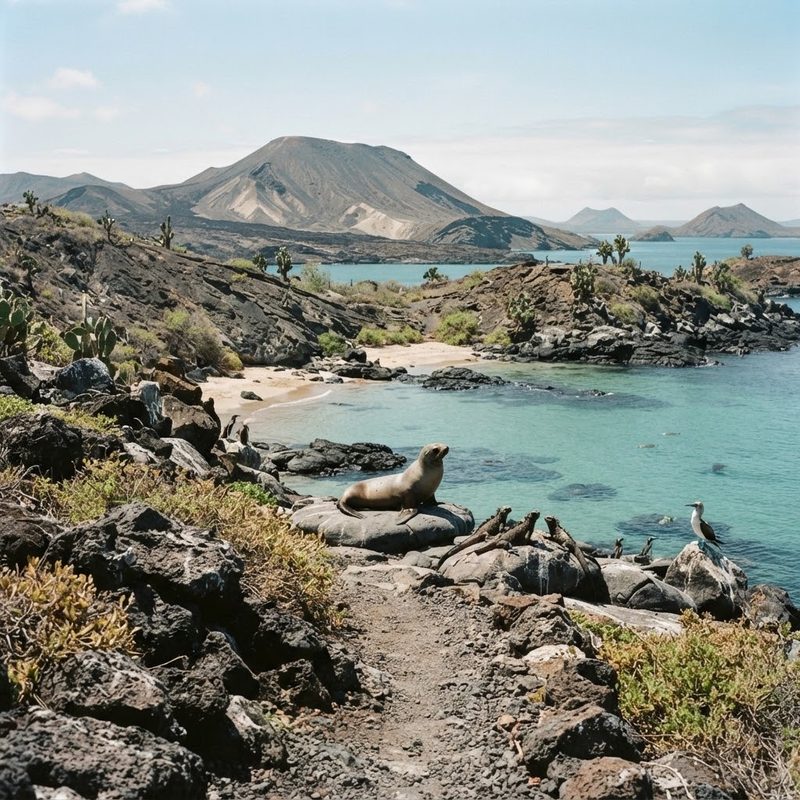
I like places named after accidents. The first official record of these islands belongs to a Spanish bishop, Thomas de Berlanga, who was sailing from Panama to Peru when his ship ran aground. Two days of equatorial current carried the wreck west of the mainland, and he ended up stepping ashore on something he had not planned to see.
He wrote to the Spanish king about an enchanted island. Pirates who worked these waters later named the small rocks after each other, and a few of those privateer names survived on old English navigation charts. What finally stuck came from the animals: galapagos, the Spanish word for land turtles, the giants that astonished everybody who landed.
Then Darwin arrived in 1835 and rearranged the whole story. The islands became the living proof behind his theory of how species change, and he called them a paradise of evolution. The travellers I meet there now often come for exactly that reason, not for a beach, but for a natural laboratory you can walk through with your own feet.
What the Archipelago Is Today
It is a province of Ecuador: nearly twenty volcanic islands and well over a hundred rocks and islets, adding up to roughly 8,000 square kilometres of land. The resident population sits around 25,000 in total. Only six islands are settled at all; everywhere else, the animals keep the place to themselves.
Even in the towns the wildlife behaves as if it owns the address. Sea lions drape themselves across piers and benches, iguanas sit along the shoreline, and nobody moves them along. Giant tortoises, marine iguanas and the most northerly penguins on the planet all survived here in isolation, which is why the islands pull in visitors from every continent.
A practical word: nearly every landing is guided, entry fees are paid on arrival, and the boats run on animal schedules rather than clock schedules. Give the place a week if you can. The flights are long, the connections are few, and hurrying defeats the point.
San Cristobal and Santa Cruz
San Cristobal is a dormant volcano and carries the provincial capital, Puerto Baquerizo Moreno, along with one of the archipelago's two airports. At the waterfront a statue of Darwin marks the harbour, commemorating his arrival in 1835. The real stars here are the sea lions: on the quay, on the sand, under the benches and on top of them, in numbers that stop being funny around the third step.
I would walk uphill to Lake El Junco, the one spot on the island where fresh water reaches the surface, then on to Frigate Hill to watch the frigatebirds wheel overhead. Cape Pitt is where the boobies nest, and divers head for Kicker Rock to swim with hammerheads and manta rays in the coastal water. Around 8,000 people live here, and in my experience they are genuinely pleased you made the trip.
Santa Cruz is the second largest island and by far the busiest. Puerto Ayora is the biggest town in the Galapagos and the harbour where nearly every excursion to the neighbouring islands begins. The highlands catch a drizzle the coast never sees, so you get black lava and desert below and wet green pasture above, a change of world you can cross by road in twenty minutes.
- Los Gemelos, twin craters collapsed into the highland scrub.
- La Galapaguera and El Chato, forest nurseries where the ancient giants feed and mate.
- Tortuga Bay, a long white beach where the waves roll in hard enough to surf.
Bartolome, Santiago and Isabela
Bartolome is the shot everybody comes for. A boardwalk stairway of 388 steps climbs to the ridge above the black cone of Pinnacle Rock, with lava lizards underfoot and hawks circling the whole way up. On the boulders at the waterline sit penguins, descendants of birds that followed the cold current north from the Antarctic centuries ago.
Santiago is the wildlife island. Darwin landed in October 1835 and recorded that the land iguanas were so numerous he could not count them, and his party could not find flat ground to pitch a tent. Sullivan Bay, with its red tufa and basalt shore, palo santo trees and towering cacti, is where I would send anyone who wants a landscape that looks invented. Sea lions use the beaches, and divers meet turtles and reef sharks.
Isabela is the largest piece of the archipelago, shaped like a chess knight, and the oddity is that it sits astride the equator, part in the northern hemisphere and part in the southern. Six volcanoes stand on the island and five of them still smoke from time to time, which explains why so few people live there. Puerto Villamil, the third largest settlement in the province, is the town to base yourself in.
The water around Isabela is the best I know in these islands: sixteen whale species have been recorded offshore, with green turtles and rays alongside them. The iguanas favour these beaches for the local algae, and a slow run up the channel to Elizabeth Bay puts you among the mangroves with blue herons and enormous frigatebirds.
Fernandina, Floreana and Espanola
Fernandina is enormous, but visitors land only at the Punta Espinoza peninsula. The volcano La Cumbre woke up in 2005 and again in 2009, so movement on the island is kept to the shoreline. The coloured lake inside the crater would be worth the walk, but it is closed to tourists for now.
What you get instead is iguanas piled on top of each other across cooled lava flows, and a swim off the rocks afterwards. Fernandina and Isabela are the only two islands where the native penguins breed.
Floreana belongs to the flamingos working the lagoon at Punta Cormorant, and to the turtles that lay their eggs in the black sand dunes behind it. Espanola is the albatross island: the cliff there gives those heavy birds the run-up they need to take off, and the hooded mockingbird lives on this island and nowhere else on earth. The iguanas here turn an unusually bright colour.
Planning the Trip
Six islands receive visitors, every site is regulated, and a guide is not optional. Most boats leave from Puerto Ayora, and the ferry between islands runs once or twice a day at best. I have missed more than one and ended up sleeping in a port hotel, which was not the plan but was never wasted time.
The order I book in:
- Flight connections first, because everything else hangs off your arrival day.
- Park entry fees next, budgeted before departure and paid on the islands.
- Inter-island boat seats last but early, since they run rarely and fill fast.
Pack reef-safe sun cream, cash for the market, and patience for early starts. The reward is an archipelago where the animals still set the terms.